The Trimesters of Grief
“I cried several times reading this memoir, but I also laughed out loud.” from the foreword, Colin Campbell Author of Finding the Words: Working Through Profound Loss with Hope and Purpose
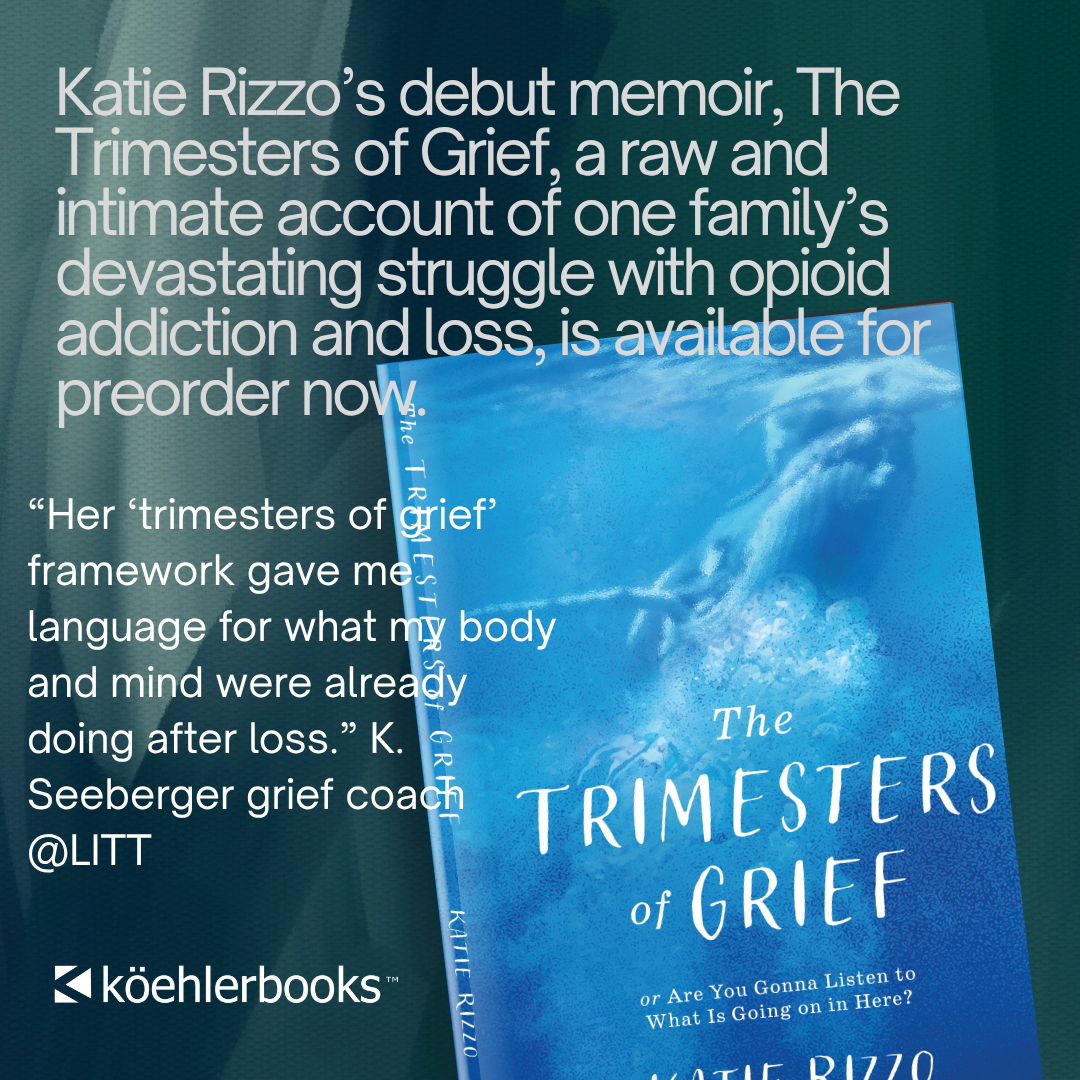
The Trimesters of Grief
Available anywhere books are sold!
there are
over eight billion people
on earth
and none of
them are you
How does someone survive the unsurvivable?
In 2024, 80,000 people in the US lost their lives to overdose. It is estimated that 48.5 million people in the US are currently struggling with addiction. Many families of those with addiction hide in the shadows. But they don’t have to.
When Katie Rizzo’s life was turned upside down by the death of her oldest son from opioid addiction, as a scientist and writer she fell back on what she knew: documenting, looking for patterns, and poetry. In The Trimesters of Grief, Rizzo shows how grief mirrors pregnancy, from whole-body fatigue to brain fog to the need to tell everyone about this precious life-a life that is now gone. And then it is time to “deliver” grief and let it sit beside us.
Pregnancy has countless guidebooks. Grief does not, especially for parents who lose children to addiction. The Trimesters of Grief is both a poetic memoir and a prescriptive guide, written by a mother navigating the devastating loss of her son to an opioid overdose.
This book reimagines grief as a gestational process:
First Trimester: silent but all-consuming, invisible to others yet physically overwhelming.
Second Trimester: grief grows, becomes undeniable, and begins shaping life.
Third Trimester: grief pushes outward, visible to the world, demanding recognition.
Delivery: the lifelong work of caring for “newborn grief”—learning to live beside it, not within it.
Katie Rizzo blends her raw journals with practical exercises, prescriptive sidebars, and original poetry. Readers are given a map not of “moving on,” but of moving forward while holding love and loss in the same hand. This book’s emphasis on the maternal perspective, its powerful use of a transformative structure for readers to follow in the trimesters as a tool for healing, not only as a story but as a companion to grief. Katie leverages practical, grounded tools like journal prompts, resilience practices, poetry, and more to provide ways to live with grief in daily life.
This book is not only for parents of children lost to addiction; it is for anyone learning to coexist with grief while reclaiming life and love. This is a guidebook to the longing.
The author encountered many parents who were stuck in sadness and hid from the world. In fact, on most websites for parents who have lost a child, the number one thing that parents say is that it never gets any better. Well, it can, and it does, and this book is a guide to how.
““The most unflinching account of loss I have ever encountered.” Mary Schaub, Podcast host, Fractals of Change
Trimesters of Grief Interview
Excerpt from The Trimesters of Grief
That fear, where my throat was almost closed, is about the same as what I began feeling the afternoon when Nicholas wouldn’t respond to texts. Something was wrong with my twenty-five-year-old kid.
“Text me back I want to talk about paying for stock brokerage classes,” I texted.
Normally if I offered money, Nicholas would respond immediately. But this time, he didn’t bite.
For a minute I considered calling Max and Joey to see if Nicholas had contacted them, but they’d been through enough.
Venmo still hadn’t reimbursed me the money that Nicholas had “rejected.” Could he have gotten Venmo to send a fake text? That seemed like a step too far, since he’d become deeper in his addiction, I couldn’t imagine him aware enough to figure out that kind of subterfuge. That kid had a pair of white flip flops that ripped on the toe almost immediately because he was stumbling around so much.
That flash – Nicholas rejected the deposit – had it come from Venmo? Or had Nicholas sent me a text then withdrawn it?
As each hour went by, I felt more and more ashamed of giving Nicholas the money, especially twice. If only all of this didn’t reek of crazy then I could tell my husband that whatever Nicholas had gotten himself into, I had given him the means.
Here was the ugly truth about addiction: just because Nicholas wasn’t thinking straight doesn’t mean I was either. Some of it was that I’d been gaslighted and some of it was wanting the gaslighting to be true. What was real? I sat there and tried to pull all the facts apart.
By that afternoon, Nick took a break from work, and although I didn’t tell him everything, I told him that I was worried.
A mask fell over Nick’s face as if he hadn’t thought about Nicholas and dinner. And I didn’t blame him, god it felt good to believe that rehab would fix our broken boy.
“Do you think he’s okay?” I asked with as normal sounding voice as I could muster.
“I assumed…” Nick said. “I’ll call; he’ll answer me.”
For a moment I had hope.
But Nick’s call went straight to voicemail.
###
Nick drove to Nicholas’s apartment.
From there Nick texted me, “He’s not answering the door.”
“Is his car there?” I responded. “Can you listen at the door and hear him?”
Nick called and without a Hi said, “Do you remember what his car looked like?”
Nicholas had been rear ended about a month prior, his truck was totaled, and he’d since gotten a new car.
“No.”
“Do you know his license plate number?”
“You’re kidding right?”
“Shit. I thought maybe you had it in a file or something.”
“No.” I said, “Is there a car in the lot with a temporary plate?”
“Yep, a few. Jesus, why didn’t I pay attention? It was blue right?”
I shook my head. “I don’t remember. It was night when I saw it. I can’t even remember if it was a two or four door.”
“I asked the front desk person,” he said. “And they can’t remember seeing him.”
###
When Nick came home, he looked at me with the eyes of a frightened kid. He marched around the kitchen, opening drawers and slamming them shut. Finally, he pulled out a card.
He said, “I’m going to ask his rehab if they saw him today.”
Surprisingly the manager of the rehab took Nick’s call. I waited with my shirt pulled up to my mouth. Although I couldn’t hear what the manager replied, I could hear Nick arguing with him.
“If you can’t tell me about him, could you tell me if you’ve seen his car in your lot, or on the street?”
Nick winced as he listened.
Then Nick said, “Can you just say that you saw him outside, at Circle K, not at your rehab, you don’t have to say where he was, just say that he is alive.”
The sound on the other end was so low, I’m guessing the manager had a quiet voice.
“Just a simple: yes or no if you have information that he’s alive is all I’m asking. You don’t have to say if he is in treatment or not.”
Just like before, I finally gave in the weight of the room and lay with my head on the island. I prayed on that cool surface that my Nicholas would be okay.
“Well, semi-good news.” Nick said as he hung up. “He claims HIPAA won’t let him say one way or another if Nicholas went to rehab today. He wouldn’t even say if he’d seen him. He offloaded a bunch of codependent things about how Nicholas is an adult that doesn’t need his parents doing things for him that he can do for himself.”
“Shit.” My stomach was turned inside out.
“But I pressed, and he finally said, ‘Look, if I was worried, I’d call the police. And I’m not calling the police.’ So that has to mean he’s seen him, right?”
Was that a secret code? Was he trying to tell us that our son is fine - and although he couldn’t say it outright - he could imply it?
Maybe Nicholas was mad at us. Maybe he’d heard the pause in my voice when he’d asked to come over. Maybe he was punishing me.
And so, I got into bed and repeated the rehab councilor’s words like a mantra, “If I was worried, I’d call the police, and I’m not calling the police,” over and over.
Nick and I had manipulated Nicholas to go to rehab. We’d attacked the problem from about as many sides as we could come up with. Surely it had to take.